
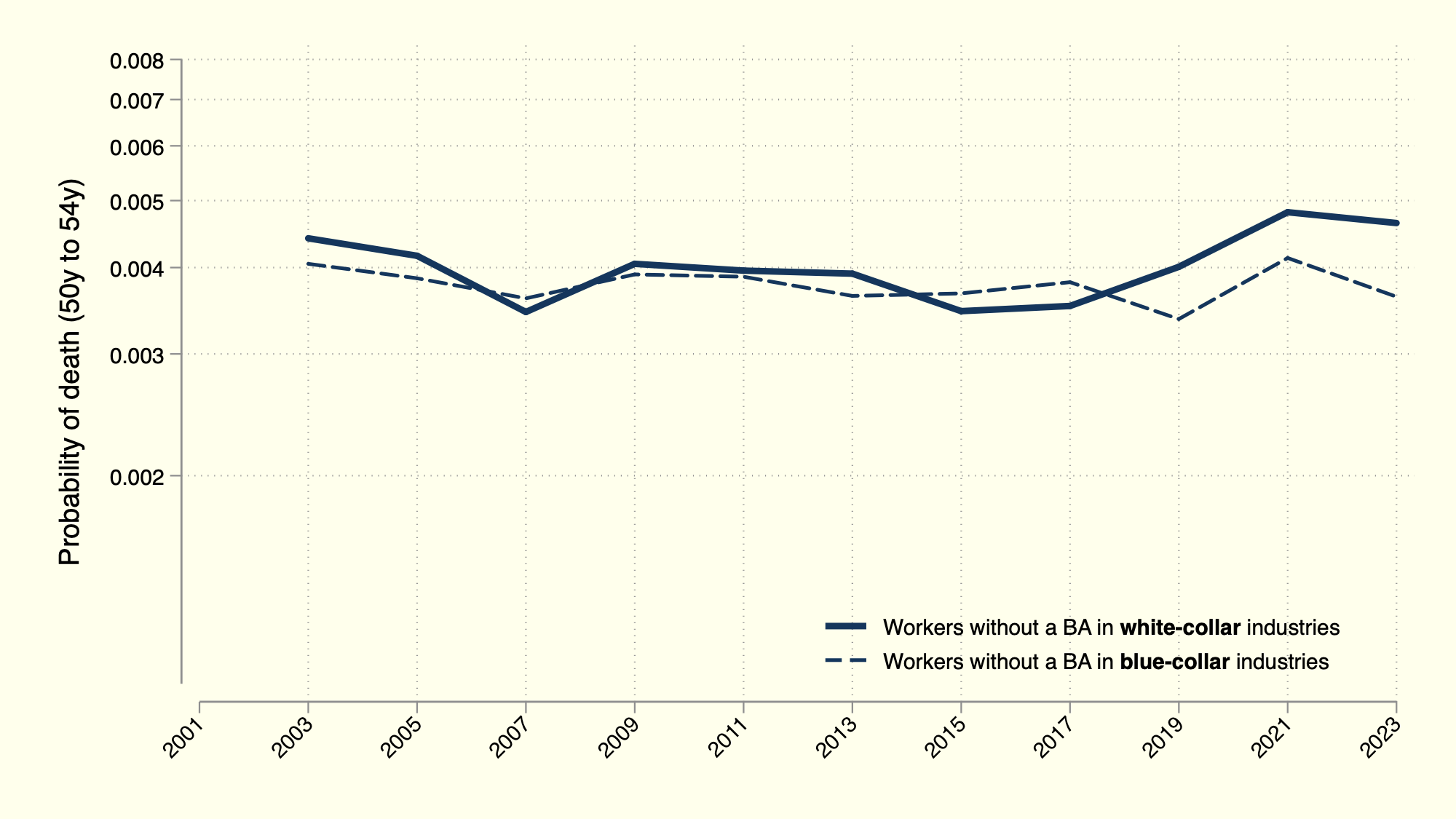
Above: We show midlife mortality rates for men without a four-year college degree working in (i) white-collar industries and (ii) blue-collar industries, namely manufacturing, construction, transportation, and utilities.
Link to working paper
Abstract
We study one of the most popular but least understood explanations for the increasingly stark advantage in longevity that highly educated Americans possess over their low and moderately educated peers: Job opportunities. Linking millions of rich household surveys to administrative death records, we first show mortality rates over time by granular levels of education, including the first estimates of mortality by college major. We confirm, in these novel data, that recent gains appear reserved for four-year-college graduates and show that even majors with relatively low earnings potential have lower mortality rates than people with an associates degree. We then plot mortality rates for various conceptions of a working class, such as men in manufacturing or other blue-collar industries, to see if the modern ails of less educated Americans bear heavily on them. We find no evidence, however, that a traditional working class is faring significantly worse than everyone else in terms of longevity. Finally, we estimate mortality gaps that are conditional on industry, occupation, income, and other labor market outcomes to more formally quantify the extent to which job opportunities can explain the growing chasm. These factors can explain a substantial portion of the educational divide, but most of that account lies in the fact that highly educated Americans are much more likely than low and moderately educated Americans to have a job at all.
Disclaimer: Any views expressed are those of the authors and not those of the U.S. Census Bureau. The Census Bureau has reviewed this data product to ensure appropriate access, use, and disclosure avoidance protection of the confidential source data used to produce this product. This research was performed at a Federal Statistical Research Data Center under FSRDC Project Number 2603. (CBDRB-FY25-P2603-R11873/12193/12623)